
Learn
Dealer hedging
A dealer may offset option delta with the underlying or a related instrument. Gamma describes how that delta changes as price moves. The hedge response depends on the book’s actual position, which a public option chain does not fully disclose.
Why the hedge changes
Suppose a dealer is short calls and hedging toward delta neutrality. When the underlying rises, the short calls’ delta becomes more negative, so buying additional underlying would offset that change. A fall makes the position less negative, which would allow some of the underlying hedge to be sold. This is the modeled short-gamma response.
For a long-gamma book, the modeled response would reverse—selling the underlying after a rise and buying after a fall. The same gamma logic applies to puts: being long a put gives negative delta but positive gamma, while being short a put gives positive delta but negative gamma.
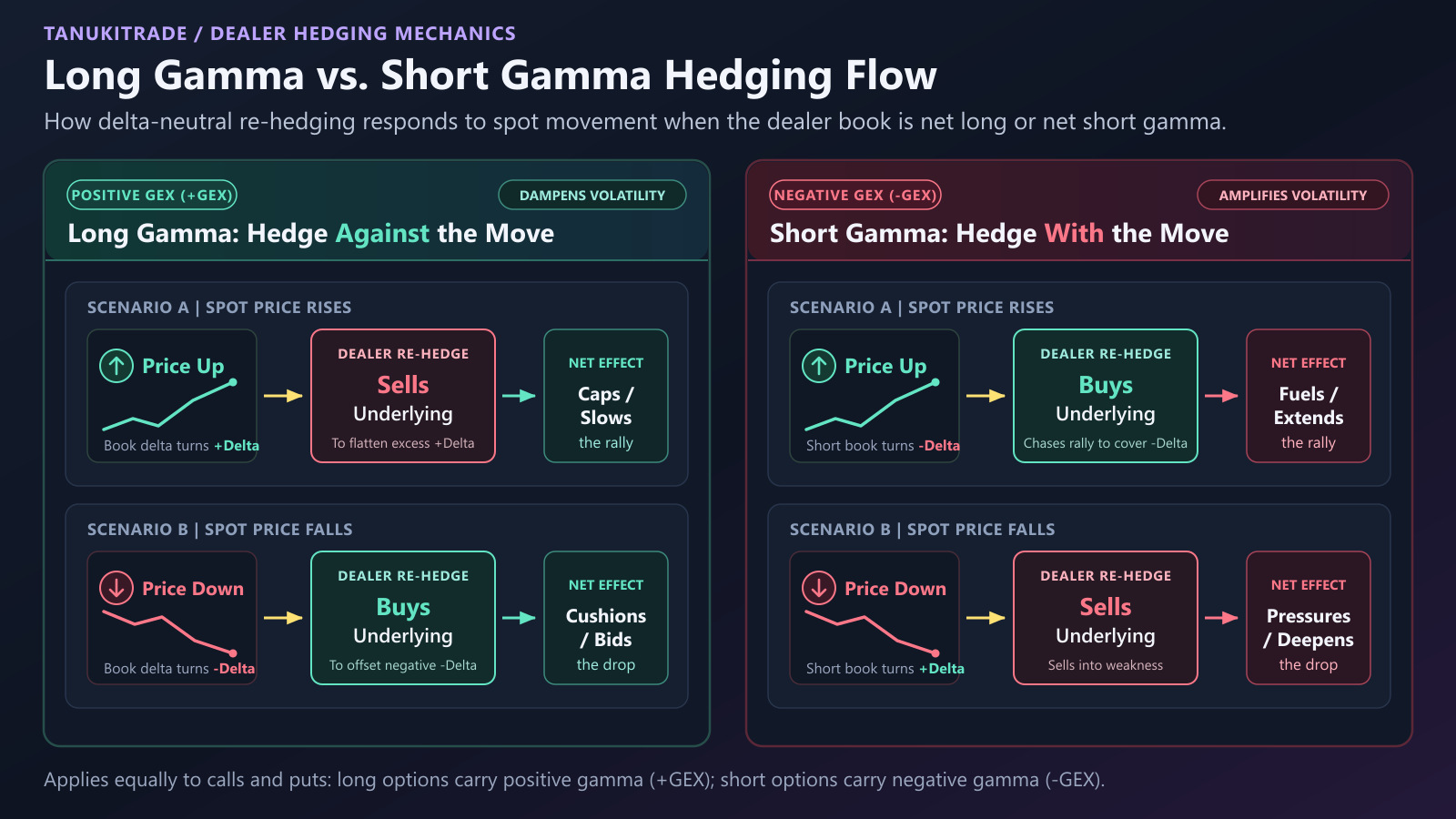
The arrows illustrate a simplified hedging response conditional on the book being long or short gamma. They do not identify the current dealer position. Original article and full example.
The same call wall can produce different outcomes
Call overwriting can leave a dealer long calls, while customer call purchases can leave a dealer short calls. In the first example, rebalancing can lean against a rise; in the second, it can add to it. The option type alone does not identify the holder or the hedge.
Index and single-stock markets can have different mixes of customer activity. Covered-call supply, protective puts, speculative demand, spreads, and offsetting positions all matter. Treat an index-versus-stock assumption as a hypothesis, not a permanent rule for every participant.
A feedback mechanism is different from a location badge
A gamma squeeze describes a possible interaction between price, short-gamma hedging, and reinforcing order flow. TanukiTrade’s extension or squeeze state labels identify price relative to the primary walls. Crossing C1 or P1 does not prove that a squeeze is occurring, and does not establish a forced path to the next wall.
Why the response remains conditional
Desks can offset risk across options and related products, hedge at different times, or tolerate some residual delta. Time and implied-volatility changes can also alter delta. The public chain therefore supports a sensitivity model, rather than a schedule of future hedge orders.
Read data clocks before interpreting any exposure model as a real-time inventory feed.
Where you see it
Use the explanation alongside GEX Live Chart and GEX Profile PRO.
TanukiTrade documentation. Levels are context, not a recommendation. tanukitrade.com